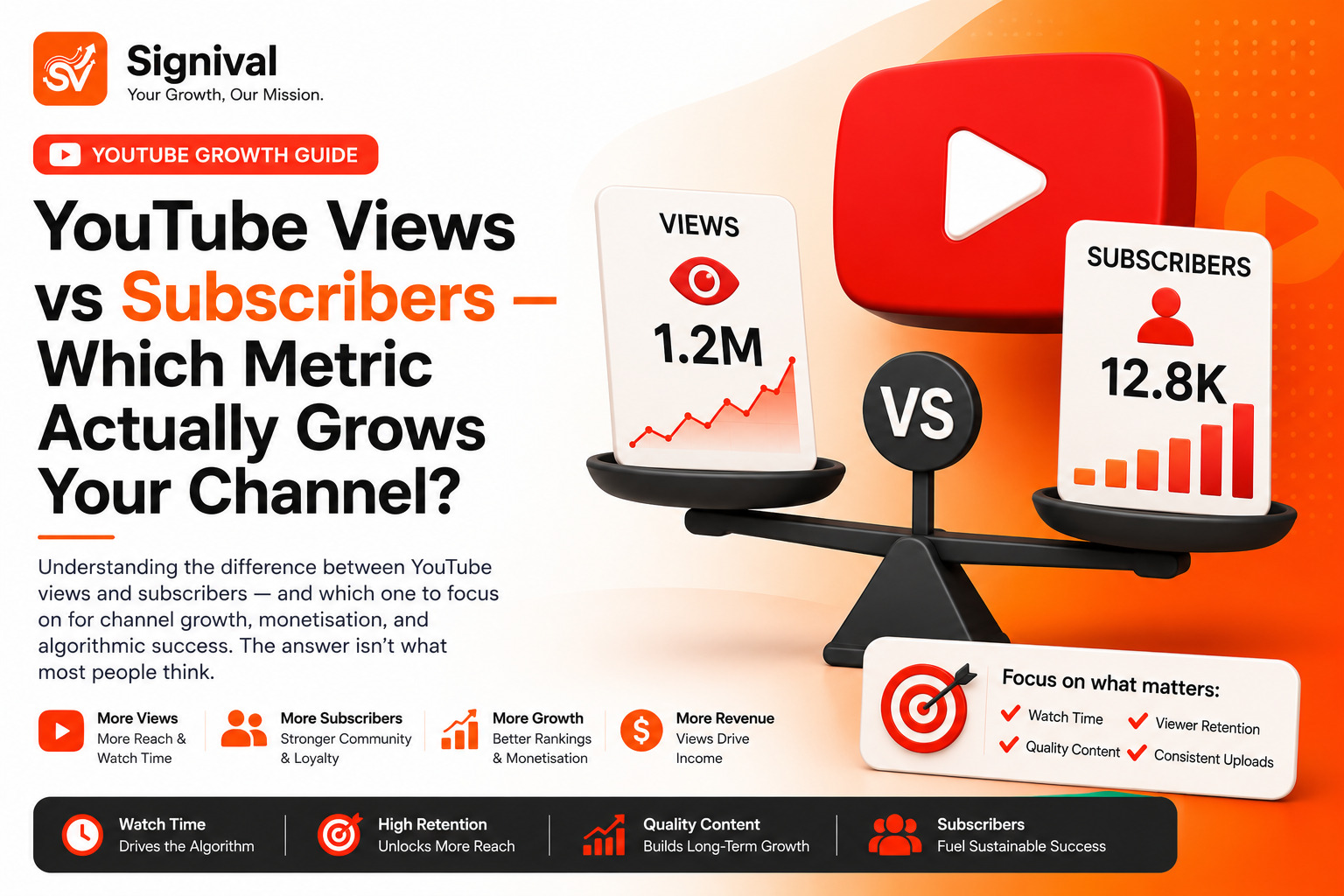
Views vs Subscribers: Which YouTube Metric Matters More?
If you are building a YouTube channel, two numbers quickly become difficult to ignore: your subscriber count and your view count.
A channel might have 500 subscribers and a video with 20,000 views. Another might have 20,000 subscribers but only a few hundred views on a new upload.
So which number actually matters more?
The answer depends on what you are trying to achieve.
Subscribers are important because they represent people who have chosen to follow your channel. Views are important because they show that people are actually watching your content. For most new creators, views are the more immediate signal of whether individual videos are reaching an audience.
Explore Signival's YouTube watch hour and subscriber services
What Do YouTube Views Actually Tell You?
A view represents a viewing event that YouTube counts according to its systems and policies.
Views are closely connected to the actual consumption of your content. If a video receives 10,000 views, it has reached a substantially larger viewing audience than a video with 100 views, although the number of views alone does not tell you how long people watched.
This distinction matters.
A video can receive many views but have poor audience retention. Another video can receive fewer views while keeping viewers watching for much longer.
That is why serious YouTube analysis goes beyond the public view counter.
Why Watch Time Matters
Watch time measures how much time viewers spend watching your content.
Imagine two videos:
Video A: 10,000 views with an average viewing time of 30 seconds.
Video B: 5,000 views with an average viewing time of 5 minutes.
Video A has twice as many views, but Video B can generate substantially more total viewing time.
This is one reason creators should not judge a video's performance from the view count alone.
Click-through rate, audience retention, average view duration, returning viewers and other analytics can provide a much clearer picture of whether a video is actually performing well.
What Do YouTube Subscribers Actually Mean?
A subscriber is someone who has chosen to follow your channel.
Subscribers can become valuable returning viewers because they have already expressed an interest in your content.
However, having a large subscriber count does not mean that every subscriber will watch every video.
A channel with 50,000 subscribers might publish a video that receives 2,000 views. Another channel with 5,000 subscribers might publish a video that reaches 100,000 viewers.
Subscriber count is therefore not a guaranteed measure of the audience a particular video will receive.
Can a Small YouTube Channel Get More Views Than Its Subscriber Count?
Yes.
YouTube can recommend videos beyond a creator's existing subscriber base.
A video can appear in search results, suggested videos, the Home feed, playlists and other discovery surfaces. If viewers respond positively to the content, the video can continue reaching people who have never subscribed to the channel.
This is why a channel with only a few hundred subscribers can sometimes produce a video that receives thousands or even hundreds of thousands of views.
The subscriber count is not a ceiling on the number of people who can discover a video.
Are Subscribers More Important for Long-Term Growth?
They can be.
Subscribers give a channel an existing audience base. When that audience is genuinely interested in the creator's content, new uploads have an opportunity to reach people who already know the channel.
A strong subscriber base can also provide a foundation for building a community around a particular topic.
But subscriber numbers are most valuable when the subscribers are actually interested in the content.
10,000 inactive or uninterested subscribers are not necessarily more useful than 1,000 highly engaged subscribers who consistently watch and interact with new uploads.
Which Metric Matters for YouTube Monetization?
This is where the distinction between views, watch hours and subscribers becomes especially important.
YouTube's current requirements for the higher YPP threshold associated with advertising revenue are either 1,000 subscribers plus 4,000 valid public watch hours in the previous 12 months, or 1,000 subscribers plus 10 million valid public Shorts views in the previous 90 days. Meeting the numbers does not automatically guarantee acceptance because YouTube reviews channels against its monetization policies.
For the long-form route, Shorts Feed watch time does not count toward the 4,000 public watch-hour requirement.
There is also an expanded YPP entry level in eligible countries, including Nigeria, with a lower threshold for access to certain fan-funding and Shopping features. That lower threshold is not the same as the higher threshold for advertising revenue sharing.
This means a creator working toward advertising monetization cannot simply focus on subscriber count.
You need the required subscriber count and the required watch-time or Shorts-view threshold.
Why 1,000 Subscribers Alone Is Not Enough
Suppose a channel reaches 1,000 subscribers.
That sounds like a major milestone, and it is. But under the long-form YPP advertising-revenue route, the channel also needs 4,000 valid public watch hours in the relevant 12-month period.
Alternatively, the creator can qualify through the Shorts route by reaching 10 million valid public Shorts views in 90 days alongside the 1,000 subscribers.
Therefore, reaching 1,000 subscribers does not automatically mean that advertising monetization is available.
Why Views Can Be More Important for a New Creator
For a new channel, views are often the first sign that the content is reaching beyond the creator's immediate network.
More views can lead to:
- More opportunities to attract subscribers.
- More watch time from eligible long-form content.
- More data about which topics audiences respond to.
- More opportunities for videos to appear in YouTube's recommendation systems.
- More opportunities to identify successful titles, thumbnails and content formats.
This does not mean that every view is equally valuable. The quality of the viewing session matters, and creators should pay attention to retention and audience behaviour rather than chasing a large counter alone.
Why Subscribers Still Matter
Views may help a video get discovered, but subscribers can help turn individual viewers into a recurring audience.
Consider someone who discovers your video through YouTube search. If they find the video useful and subscribe, they have now created a stronger connection with your channel.
If that viewer later watches another upload, the relationship becomes more valuable.
This is how views and subscribers work together.
Views bring people into the channel. Good content gives them a reason to stay. Subscribers provide one way of maintaining that connection.
Views Do Not Automatically Mean Ad Revenue
Another common misunderstanding is that every YouTube view produces advertising income.
That is not how YouTube monetization works.
Revenue depends on factors such as whether the channel is monetized, whether an advertisement is served, the type of content, viewer location, advertiser demand and other monetization conditions.
YouTube also has separate monetization systems for different features, including Watch Page ads, Shorts Feed ads and YouTube Premium revenue.
So a creator should not assume that multiplying a video's views by a fixed advertising rate will produce an exact earnings figure.
What Should a New Nigerian Creator Focus On?
If you are starting from zero, focus first on creating content that people actually want to watch.
That means choosing topics with a clear audience, creating useful or entertaining videos, improving thumbnails and titles, and studying the analytics after each upload.
Views should be used to understand whether your content is reaching people.
Subscribers should be used to understand whether some of those viewers are choosing to continue following your channel.
Watch time and retention help you understand whether those viewers are actually consuming the content.
None of these metrics should be treated in isolation.
Should You Focus on Views or Subscribers First?
For a new creator, I would prioritize getting people to watch the content rather than obsessing over the subscriber number.
A video that reaches 10,000 relevant viewers has created thousands of opportunities to gain subscribers. A channel with 10,000 subscribers but very little active viewership has a much weaker immediate content signal.
The goal should therefore be to create a cycle:
- Create useful content.
- Get the content discovered.
- Turn viewers into returning viewers.
- Convert interested viewers into subscribers.
- Publish more content that keeps those viewers watching.
That is a much healthier growth strategy than chasing one metric.
Where YouTube Views and Subscribers Fit Into an SMM Strategy
Creators and marketers sometimes use SMM services when they want to increase the visible metrics associated with particular content or channels.
These services should not be confused with building a genuine YouTube audience. Purchased metrics do not replace useful videos, audience retention, returning viewers or a sustainable content strategy.
If you are considering an SMM service, understand exactly what the service delivers and whether it is intended for views, subscribers, watch hours or another metric.
See Signival's YouTube watch hour and subscriber services
The Bottom Line
So, are YouTube views more important than subscribers?
Neither metric is universally more important.
Views show that people are watching your content and can help generate watch time and discoverability.
Subscribers show that viewers have chosen to follow your channel and can provide a foundation for future audience growth.
For monetization, the distinction becomes even more important because YouTube's requirements combine subscriber thresholds with either valid public watch hours or valid public Shorts views.
The strongest YouTube channels do not choose between views and subscribers. They create content that earns views, then turn those viewers into an engaged audience.