The Real Difference Between Views and Subscribers
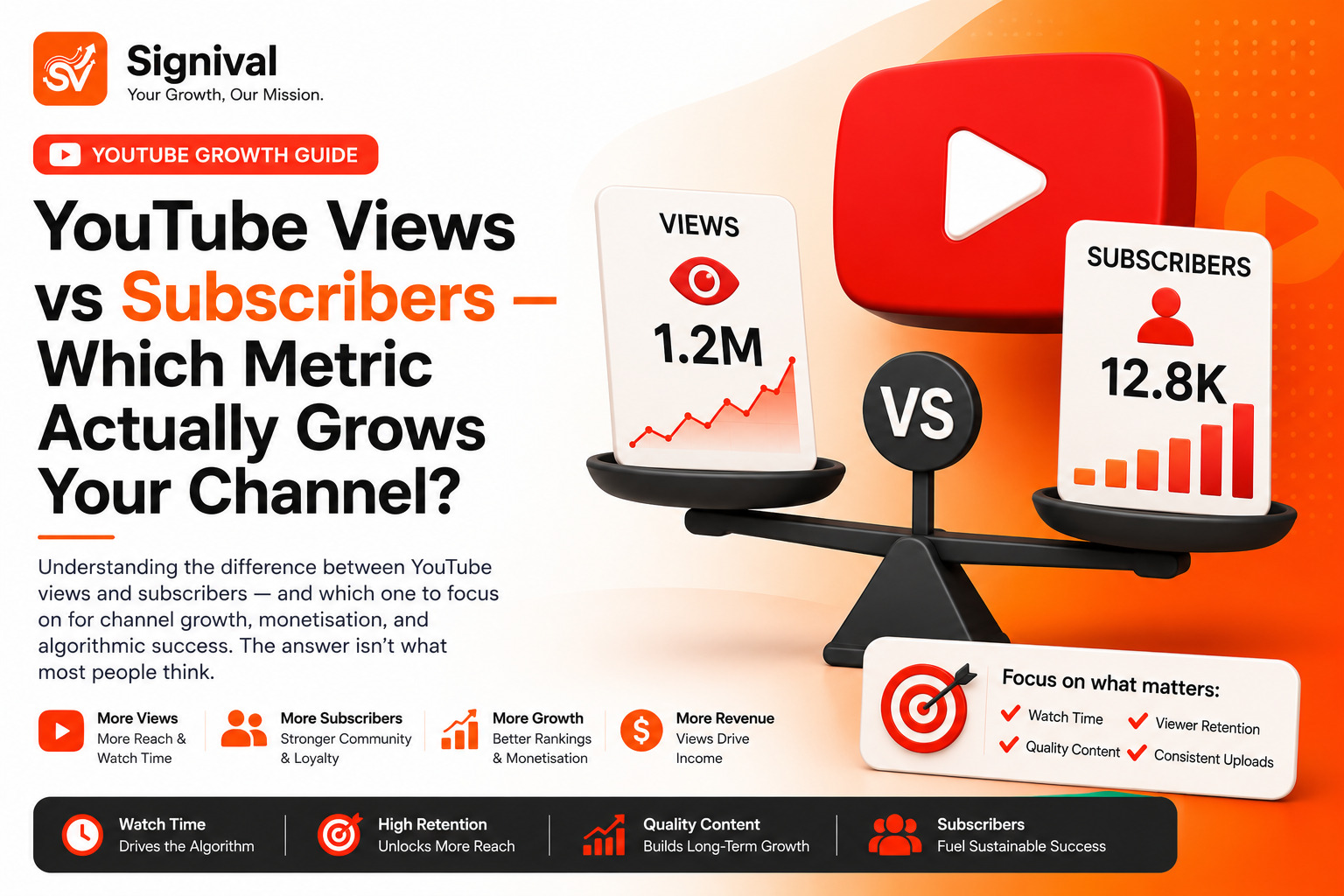
Most new YouTubers focus intensely on subscriber count as the primary measure of their channel's success. It's a visible, shareable number. It feels like progress. But from a purely algorithmic and revenue perspective, views and watch time are significantly more important metrics than subscriber count — especially in the early stages of a channel.
Here's why the distinction matters:
- Views generate ad revenue directly. Each monetised view produces income. Subscribers don't.
- Watch time determines algorithmic reach. YouTube's recommendation system prioritises videos that keep viewers on the platform longer. A channel with 500 subscribers and excellent watch time will often outperform a channel with 5,000 subscribers and poor watch time in recommendations.
- Subscriber count affects the size of your immediate audience for each new upload. When you publish a video, YouTube notifies subscribers and shows it to a portion of them first. More subscribers means a larger initial test group — which matters for the algorithmic snowball effect.
The relationship between views and subscribers is cyclical: views attract subscribers, and subscribers generate consistent views on future uploads. But in the early stages, prioritising view quality (watch time, completion rate) produces better long-term results than chasing raw subscriber numbers.
How YouTube's Algorithm Actually Works
YouTube's recommendation algorithm in 2026 operates in two distinct phases:
Phase 1: Initial distribution. When you publish a video, YouTube distributes it to a small test audience — primarily your existing subscribers and users who've recently watched similar content. It measures how these viewers respond. The key signals: click-through rate (do people click the thumbnail?), average view duration (how much of the video do they watch?), and likes/comments.
Phase 2: Broader recommendation. If Phase 1 metrics are strong, YouTube begins recommending the video to broader audiences through suggested videos, the homepage, and search results. This is where viral growth happens — not from subscribers, but from the algorithm's recommendation engine.
The implication: a video that performs well in Phase 1 can reach millions of people regardless of subscriber count. A video that performs poorly in Phase 1 will reach almost no one, even with 100,000 subscribers. Content quality and viewer satisfaction drive algorithmic success more than follower count.
When Subscribers Matter Most
Subscribers become increasingly important as a channel matures. Here's when subscriber count has direct impact:
- YouTube Partner Program eligibility — you need 1,000 subscribers before you can monetise. This threshold exists as a quality filter, not because subscribers are algorithmically important at that number.
- Consistent baseline views — a larger subscriber base means each new upload gets more immediate views, improving Phase 1 performance and making it easier to trigger wider recommendation.
- Channel memberships and Super Thanks — these monetisation features are used primarily by subscribers. A highly engaged subscriber base generates more channel membership revenue than a large disengaged one.
- Brand credibility — subscriber count is a social proof signal for brands evaluating sponsorships. A channel with 50,000 subscribers is seen as more established than one with 5,000, even if the smaller channel has better engagement metrics.
The YouTube Partner Program: What You Actually Need
To qualify for monetisation through the YouTube Partner Program (YPP), you need to meet one of two thresholds:
Standard YPP (for long-form video):
- 1,000 subscribers
- 4,000 watch hours in the past 12 months
Shorts-specific YPP:
- 1,000 subscribers
- 10 million Shorts views in the past 90 days
The watch time requirement is often the harder threshold to reach for new channels — yet most new creators focus on subscribers. 4,000 watch hours equals 240,000 minutes of total watch time across all your videos in a year. A channel posting 10-minute videos needs approximately 24,000 complete video views to qualify. For most niches, reaching 1,000 subscribers happens before 4,000 watch hours.
Using SMM Services Strategically for YouTube Growth
SMM services for YouTube work most effectively when they're used to solve specific bottlenecks rather than as a general growth strategy:
Subscriber services are most useful for crossing the 1,000-subscriber threshold for YouTube Partner Program eligibility. Once you're monetised, the focus shifts to organic growth through content quality. Use Signival's subscriber services with drip-feed delivery — gradual growth looks natural and is more stable than overnight spikes.
View services are most useful for boosting specific videos that you want to rank in YouTube search or trigger algorithmic recommendation. Signival offers high-retention YouTube views — views where a significant portion of the video is watched. High-retention views increase your video's average view duration metric, which is one of the strongest ranking signals in YouTube's algorithm.
Watch time packages directly address the YPP watch hour requirement. Signival's watch time services deliver hours toward your 4,000-hour goal using high-retention viewing patterns that count toward the total.
YouTube SEO: Getting Found Without the Algorithm
Beyond recommendations, YouTube functions as the second largest search engine in the world. Ranking in YouTube search provides consistent, passive view generation that compounds over time. Key YouTube SEO factors in 2026:
- Title with target keyword — include your primary keyword naturally in the video title, ideally in the first half. "How to Make Sourdough Bread at Home" outperforms "My Weekend Baking Adventure — Sourdough" for search.
- Description with keyword context — the first 150 characters of your description appear in search results. Use them to describe the video's value and include target keywords naturally.
- Tags as secondary keywords — less important than they used to be, but still useful for telling YouTube what your video is about. Use specific phrases, not just single words.
- Chapters (timestamps) — adding chapter markers helps YouTube understand your video's structure and can generate "key moments" in search results, increasing click-through rate.
- Closed captions — upload an accurate transcript. YouTube reads captions for indexing, and accurate captions perform better than auto-generated ones.
Thumbnails: The Single Biggest Lever on Click-Through Rate
YouTube's own data consistently shows that thumbnails are the largest variable in click-through rate — which is a direct input to algorithmic recommendation. A video with identical content but different thumbnails can see 2–3x differences in click-through rate depending on thumbnail quality.
Principles of high-performing YouTube thumbnails in 2026:
- Human faces expressing strong emotion outperform every other thumbnail type in A/B tests
- High contrast between background and foreground — your thumbnail needs to stand out against YouTube's white background
- Text is optional but should be minimal — if you use text, 3–4 words maximum in large, readable font
- Consistent style across all thumbnails — recognisable thumbnails build brand identity that increases click-through from subscribers who recognise your style